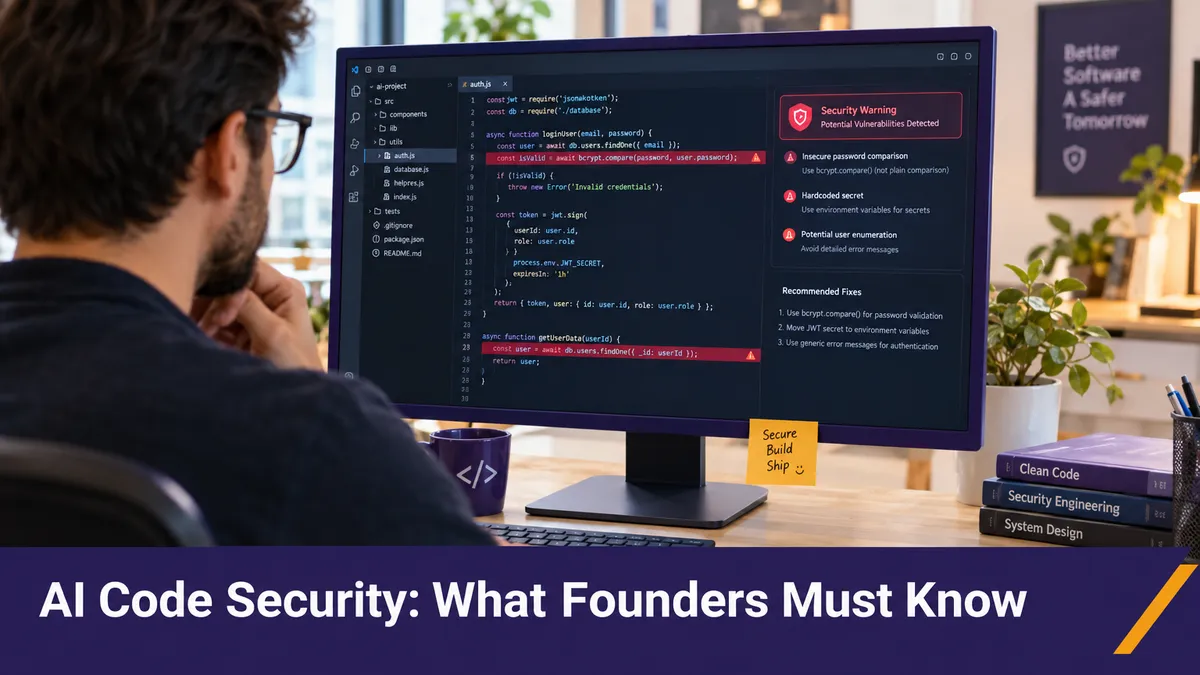
Why Does AI-Generated Code Keep Failing Security Tests? What Every Founder Needs to Know
The Data Is In — and Every Founder Building With AI Needs to See It.
If you’ve built an app using AI coding tools, there’s a statistically meaningful chance it contains a security vulnerability you haven’t seen yet. That’s not fear-mongering — it’s what the 2026 security data consistently shows across multiple independent research studies. The good news is that you can understand the problem, take practical steps to close the most critical gaps, and launch with confidence rather than crossed fingers.
This post explains why AI-generated code fails security tests so often, what the real-world consequences look like for founders, and what a responsible pre-launch security approach looks like — in plain language, without requiring an engineering degree.
Key Takeaways
- Independent studies confirm that AI-generated code carries significantly more security vulnerabilities than human-written code — and the rate hasn’t improved as AI tools have become more popular.
- The most common failures are OWASP Top 10 issues — SQL injection, cross-site scripting, and missing access controls — not obscure edge cases.
- Real-world data breaches from vibe-coded apps have already exposed millions of user records in 2025–2026.
- Founders don’t need to read every line of code, but they do need a security review process before launch — especially for apps handling user data, payments, or sensitive information.
- AI accelerates your build. Human review makes it safe to ship.

The Numbers Are Consistent — and They Matter
Security research on AI-generated code doesn’t come from a single study. It comes from multiple independent organizations all reaching the same uncomfortable conclusion.
Veracode tested over 100 large language models on security-sensitive coding tasks and found that 45% of AI-generated code samples introduce OWASP Top 10 vulnerabilities — a pass rate that has not improved across multiple testing cycles. Empirical research across Fortune 50 enterprises found that AI-assisted developers produce commits at three to four times the rate of their peers but introduce security findings at 10x the rate, creating a security debt that accumulates faster than organizations can remediate it.
Why Does AI Code Fail at Security?
This isn’t a mystery, and it doesn’t mean AI tools are broken. It means they’re doing exactly what they’re designed to do — generate functional code quickly — and security is a constraint that often conflicts with that goal.
Large language models learn to generate code by studying vast amounts of existing code from public repositories. The fundamental problem is that this training data reflects historical coding practices, including historical security flaws. When a model sees thousands of examples of SQL queries written with string concatenation — a known vulnerability pattern — it learns to replicate that approach because it’s statistically common, not because it’s safe.
The most frequently failing vulnerability categories include:
- SQL Injection — Improper database query construction that allows attackers to manipulate your data.
- Cross-Site Scripting (XSS) — 86% of AI-generated samples failed to defend against XSS in controlled testing.
- Missing access controls — 41% of AI-generated backend code includes overly broad permission settings.
- Hardcoded secrets — API keys and database credentials left directly in the code where they can be discovered.
Real-World Consequences: What Happens When This Goes Live
These aren’t abstract statistics. Real applications built by real founders have already paid the price.
CVE-2025-48757 revealed that Lovable had been generating Supabase schemas without Row Level Security, exposing over 170 production applications. Moltbook leaked 1.5 million authentication tokens and 35,000 email addresses because API endpoints returned sensitive data without checking authorization.
This is the cost of skipping the review step — not the cost of using AI tools, but the cost of not pairing them with human oversight.
What a Responsible Pre-Launch Security Approach Looks Like
You don’t need to become a security expert. You need a process that catches the most critical gaps before real users encounter them.
Step 1: Automated scanning — Run free static analysis tools against your codebase to catch common patterns. Tools like Semgrep, Snyk, or GitHub’s built-in security scanning can surface obvious issues quickly.
Step 2: Secrets check — Verify no API keys, passwords, or credentials are hardcoded in the code or visible in your Git history. Use environment variables exclusively for sensitive configuration.
Step 3: Access control review — Confirm that every data endpoint requires authentication, that users can only see their own data, and that admin functions are properly restricted.
Step 4: Professional review before launch — Every application with real users or payment processing should receive a manual security assessment before going live. Automated scanners miss the majority of AI-specific vulnerability patterns.
Step 5: Ongoing monitoring — Security isn’t a one-time checkbox. Once you’re live, you need logging and monitoring so you can detect and respond to problems quickly.
FAQ
Does the specific AI tool I used affect my security risk?
The tool matters less than the review process. Research shows that closed-source and open-source AI models produce vulnerable code at similar rates. What matters most is whether a human reviewed the output before it went live — not which AI generated it.
What are the most common security issues in vibe-coded apps?
The most common issues are: disabled row-level security, hardcoded API keys or credentials, missing authorization checks on API endpoints, absent rate limiting on login and payment forms, and no security logging or monitoring. Most of these are fixable — but you need to know they’re there first.
How much does a security review typically cost?
Basic automated scanning is free with most code hosting tools. A manual professional security review for a small app typically runs from a few hundred to a few thousand dollars — far less than the cost of a breach, a data exposure incident, or an emergency rebuild.
Conclusion
AI coding tools have genuinely changed what founders can build. But the security data from 2026 is consistent and clear: speed without review is a liability, not a strategy. Understanding the risk doesn’t mean abandoning the tools — it means using them with the governance layer they need.
Talk with Revealio’s team about security review and production readiness for your AI-built project — before your users find the gaps for you.